

Dr. Caroline Fiddler: The Doctor Who Saw Healthcare From The Other Side
There are moments in healthcare when the problem is not a lack of knowledge.
The doctors know what needs to happen. The nurses know what needs to be communicated. The
patient has been given the instructions.
And yet, somewhere between the clinic, the phone call, the piece of paper and the patient’s
kitchen at home, something becomes unnecessarily difficult.
For Dr Caroline Fiddler, Founder of CycleGuide, that gap became impossible to ignore.
She had spent years on the other side of healthcare as a doctor. She understood medical systems,
clinical decision-making, and the complexity of treatment. She had worked across different
medical specialties, healthcare settings, and states in Australia. She knew how hospitals operated,
and she had repeatedly seen opportunities to simplify and streamline workflows.
Then she became an IVF patient.
Suddenly, she was no longer the doctor observing the system from inside it. She was the person
expected to navigate it.
Medications to administer at precise times. Instructions that changed throughout the cycle. Blood
tests, ultrasounds, procedures, and appointments. Medication storage requirements. Calls from
clinics. Written instructions. Verbal instructions. Different clinics. Different doctors. Different
processes.
And beneath all of it was something that no calendar could fully organise: the uncertainty of
whether the treatment would work.
That experience eventually became CycleGuide, a purpose-built IVF organiser designed to help
patients manage medications, appointments, injections and treatment instructions in one place.
But CycleGuide is not really the story of an app.
It is the story of a doctor who became a patient, saw healthcare from the other side, and decided
that one frustrating problem deserved a better answer.
“There must be a better way.”
When the System Becomes Personal
Dr. Fiddler’s professional journey began with a fascination for science at school and eventually
led her to medical school. Her career gave her exposure to a variety of specialties and healthcare
environments across Australia.
She loved many parts of medicine.
The interaction with patients and families was rewarding. The intellectual discipline of
establishing differential diagnoses was stimulating. Medicine offered an unusual combination of
human connection and analytical problem-solving.
The systems surrounding that work were another matter.
Dr. Fiddler describes hospitals where paper records, electronic medical records, and multiple
disconnected digital systems coexist. A cardiology application might hold ECGs while the main
hospital record sits somewhere else. Outpatient notes may be separate again, with emergency,
intensive care and oncology systems adding further layers.
Even hospitals within the same state can operate differently.
For someone interested in efficiency, the fragmentation was frustrating. Dr. Fiddler had
suggested workflow improvements in multiple workplaces, but many of those suggestions went
nowhere. Hospital hierarchies, established processes, and institutional inertia could make even
sensible changes difficult.
Then IVF offered a different kind of lesson.
As a patient, she was no longer looking at healthcare as someone responsible for delivering
treatment. She was the person who had to carry out the instructions after leaving the clinic.
“Being a patient and undergoing IVF gave me a unique insight that I never saw as a
medical student or doctor.”
That distinction became central to the story of CycleGuide.
The Part of IVF That Happens After The Appointment
Fertility treatment is usually presented through its clinical milestones.
Egg collection. Embryo development. Transfer. And pregnancy.
But between those milestones is a substantial amount of work that belongs to the patient.
The most intense part of Dr. Fiddler’s experience was the two-to-three-week period around egg
collection and embryo transfer. During that window, patients may suddenly become responsible
for coordinating a small operational system of their own.
They have to remember medications and dosages. They may have to administer injections at
precise times and through the correct route. They need to store medications appropriately. Blood
tests and ultrasounds need to be attended. Procedures need preparation. Work schedules may
have to change at short notice.
The clinic may be highly organised. The patient still has to take the instructions home. That is
where Dr. Fiddler identified a gap.
The treatment itself was not necessarily the problem. The challenge was managing everything
that treatment required once the patient was outside the clinical environment. Her questionnaire
describes the experience as particularly difficult because the responsibility sits alongside the
uncertainty of whether treatment will ultimately result in a baby.
CycleGuide’s current positioning reflects that same practical problem. The platform focuses on
medications, injections, appointments, and treatment instructions, while acknowledging the
mental burden of trying not to miss something important.
It is a deceptively ordinary problem.
Which may be why it had been so easy to overlook.
The Cost Of Getting It Wrong
There is also a financial reality to IVF that makes organisation more than a matter of
convenience.
In Australia, Dr. Fiddler explains, fertility treatment is predominantly private. Medicare can
significantly reduce medication costs and contribute to treatment cycles, but patients can still
face substantial expenses.
Her own egg collection cycles cost approximately $10,000 to $12,000, with roughly half
returned through Medicare. Embryo transfers cost around $2,000 to $4,000 using her own eggs
and approximately A$6,000 using overseas donor eggs. Private health insurance could assist with
certain theatre-based procedures, while other treatments carried no comparable rebate.
The financial figures add another layer to the emotional reality.
A patient is not simply trying to remember whether an injection belongs in the refrigerator.
They may be managing an expensive treatment cycle that represents months of preparation,
considerable personal sacrifice, and the possibility of becoming a parent.
That context matters when considering why Dr. Fiddler became so focused on something as
seemingly mundane as treatment instructions.
If the treatment is high-stakes, the system supporting the patient should be dependable.
The Decision To Take The Risk
Dr. Fiddler was not looking for a startup idea. She was not a technology entrepreneur searching
for an industry to disrupt. She was a doctor who had encountered a problem and could not stop
thinking about it.
The first obstacle was not technical. It was financial.
Developing an app required a significant investment, and Dr. Fiddler was understandably
cautious. She knew other fertility apps existed. What she could not find was a product that
matched the particular gap she had experienced: a simple, purpose-built system for managing
fertility treatment instructions.
That raised another question.
If IVF had been available for decades and was performed across the world, why did such a basic
organisational problem still feel unresolved?
There was no guarantee that her answer would work.
But there was something she feared more than failure: never finding out.
“I could live with failure, but it would always worry me if I didn’t have a go.”
So she invested in the idea. And CycleGuide began.
Designing For The Real World
The first principle was not technological sophistication. It was restraint.
Dr. Fiddler wanted CycleGuide to be simple, lean, and purpose-built. She deliberately resisted
the temptation to turn it into a giant fertility platform with every possible feature.
That decision shaped the product. The main interface uses a whole-month calendar because an
IVF cycle generally fits within two to three weeks. Beneath the calendar sits the task list for the
current day, allowing users to see what needs to happen immediately while still understanding
where they are within the larger cycle.
The tasks are colour-coded around the basic components of fertility treatment:
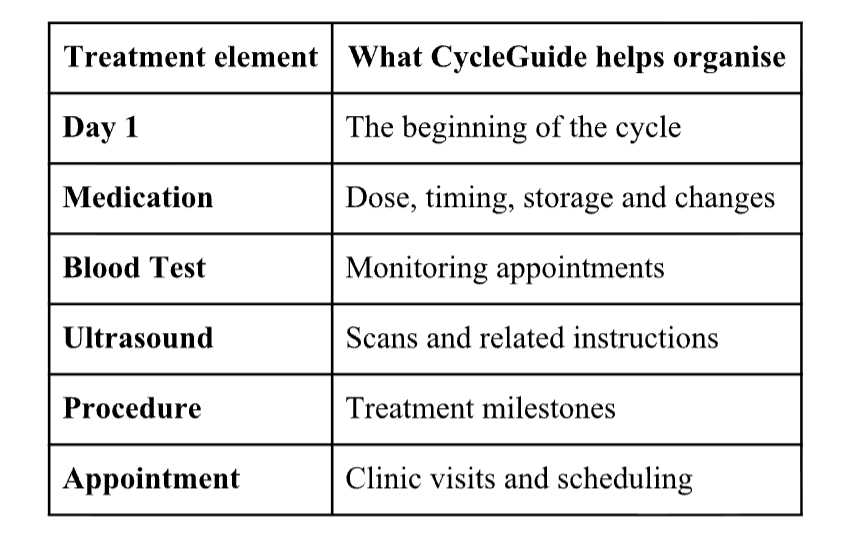
The design philosophy extends to the individual screens. Dr. Fiddler deliberately kept options
and fields limited so users would not have to scroll unnecessarily or search through excessive
information. Tasks can be modified as treatment changes, including medication end dates,
because IVF protocols can shift based on test results. Notifications provide reminders for time-
sensitive tasks.
The current CycleGuide platform similarly brings medication records, appointments, treatment
notes, and the overall treatment calendar into one place.
The restraint is not accidental. It is the product.
From A Piece of Paper To Something That Can Move
The problem becomes clearer when the traditional alternative is examined closely.
Dr. Fiddler’s IVF instructions were often provided through standardised paper tables. They were
useful at first, but their limitations became increasingly obvious as treatment progressed.
A sheet might contain the cycle day, date, and instructions, yet omit the actual day of the week.
That matters when certain tests are unavailable on weekends.
The sheet could not automatically extend if a cycle lasted longer than expected. It could become
worn or faded. It could be misplaced. And it could not send a reminder when an injection was
due. The telephone created another vulnerability.
Patients could miss calls. They could misunderstand instructions. They could write something
down incorrectly or lose the note. If uncertainty emerged after the clinic closed, there might be
no immediate opportunity to clarify it.
CycleGuide’s integrated model was designed around that precise communication gap.
Rather than asking clinic staff to reinvent their instructions, the integrated version allows existing
instructions to be sent directly to a patient’s phone, creating written confirmation alongside the
verbal communication.
The distinction is important. CycleGuide does not attempt to become the doctor. It does not
attempt to replace clinical judgement. It is designed to carry the information between the clinic
and the patient more effectively. That narrow focus is one of its strengths.
Preparation Before Day One
One of CycleGuide’s more revealing features is its pre-cycle checklist. It came directly from Dr.
Fiddler’s own experience across multiple IVF cycles. The questions are practical rather than
glamorous.
Does the patient know what actually counts as Day 1? Are they prepared if Day 1 arrives earlier
than expected or on a weekend? Do they know how to assemble their injectable medication? Do
they understand how and where medications should be stored? What happens if medication
needs to be managed at work?
These questions illustrate the difference between knowing the medical protocol and being
prepared to live through it.
Healthcare systems are generally designed around clinical encounters. Patients live the treatment
in kitchens, bedrooms, workplaces, cars and supermarket car parks. CycleGuide was designed
for that second environment.
A Product Shaped By Its Founder's Own Cycles
CycleGuide was not built from a distance.
Dr. Fiddler designed and tested it while undergoing IVF herself, across different clinics, doctors,
staff members and processes. She was also working in healthcare settings in regional Victoria
while developing the product.
That gave her something most health-tech founders do not have: repeated exposure to the
problem from both sides.The medical perspective helped her understand the treatment. The patient perspective showed
her what the treatment actually demanded. The founder perspective forced her to decide which
problems were worth solving. There were plenty of potential targets.
Dr. Fiddler noticed uncomfortable baby-related small talk in fertility settings. She noticed baby
photographs in waiting rooms. She noticed IVF patients being directed to general women’s
ultrasound clinics where they could be surrounded by pregnant women attending obstetric
appointments.
There was no shortage of things that could be improved. She deliberately chose one.
Treatment instructions were, in her view, among the most complex, stressful and patient-
dependent parts of IVF.
The decision reflects another element of her philosophy:
Do not try to fix everything at once. Solve the important problem first.
The Moment CycleGuide Stepped Outside Australia
CycleGuide’s development has followed a steady progression rather than a single overnight
breakthrough.
The initial prototype was designed in 2022 by Sharon Huang Liang, then a Product Designer at
Appetiser Apps. The app launched in January 2024, around the birth of Dr. Fiddler’s IVF baby,
Alice. It was subsequently integrated with a fertility clinic in metropolitan New South Wales in
early 2025.
That integration ultimately ended when the clinic chose to use another portal, but Dr. Fiddler still
regarded the experience as valuable because it demonstrated how clinic staff could send existing
treatment instructions directly to patients.
Then came international recognition.
In July 2026, CycleGuide was shortlisted in the Best Treatment Support and Coordination
category at the Fertility Care Awards held in connection with the European Society of Human
Reproduction and Embryology conference in London. Dr. Fiddler did not win, but the
recognition was significant to her because it validated the problem she had identified and the
approach she had taken to solving it.
CycleGuide was also featured among the Worthy 100 by Worth Minds in August 2026.
The platform has moved beyond its original Australian base as well. The questionnaire identified
Australia and New Zealand as existing markets, with the UK and USA in progress and Singapore
and Canada next. The current company website now lists Australia, New Zealand and the United
Kingdom as markets where the iOS app is available.
For a product that began with one doctor’s frustration over a photocopied sheet of instructions,
the trajectory is considerable.
Leading By Knowing What Not To Build
Perhaps the most interesting part of Dr. Fiddler’s leadership style is what she deliberately refuses
to add.
CycleGuide is not designed to become a fertility social network.
It does not attempt to create community groups or chat functions.
Dr. Fiddler describes keeping the product “tight and legitimate,” with careful attention to the
boundaries of her expertise. She works with a colleague when she wants to test an idea and
consults lawyers specialising in technology products to ensure the company complies with
relevant legislation.
This is more than product discipline. It is a leadership philosophy.
In a market where adding features can be mistaken for adding value, Dr. Fiddler has chosen to
ask a more difficult question:
Does this actually make the patient’s experience better?
If the answer is no, it does not need to be there.
The Personal Story As A Professional Tool
Dr. Fiddler has also built a distinctive public voice around her experience.
She writes blogs, attends conferences, appears in magazines and uses social media to discuss
aspects of IVF that patients may struggle to find elsewhere.
She has shared treatment instructions, medications, de-identified forms, good news and bad
news. The approach is deliberately personal without becoming careless.
She does not want to imitate the tone of other social media personalities. She wants to remain
professional because her audience includes both patients and clinics. Most importantly, she is
conscious of the boundary between supporting patients and interfering with their clinical care.
That balance gives her public voice credibility.
And she continues to use and promote CycleGuide while undergoing IVF again in an attempt to
have a second child, using overseas donor eggs because of her age and undergoing embryo
transfers interstate because of legislation in Victoria.
The story, therefore, is not something that happened to her once.
It continues to inform the product.
The Courage To Ignore Some Advice
Entrepreneurship inevitably creates opinions.
People suggest features, identify problems, and explain why a product may not work. Dr.
Fiddler’s response is not to ignore feedback, but neither is she prepared to let every opinion
reshape the original idea.
She believes in keeping an open mind while maintaining what she calls a healthy disregard for
criticism that does not align with the problem she is trying to solve.
Her personal principles are straightforward:
Have the courage of your convictions. Trust your gut instinct. Let common sense prevail.
Remember that efficiency matters. If you can afford to try, have a go.
That philosophy became particularly important because the financial risk was real.
Dr. Fiddler admits that, had she known in advance how difficult it would be to develop an app,
promote it and convince people that it solved a genuine problem, she might never have started.
Instead, she was “blissfully ignorant.”
And perhaps that ignorance was useful.
Because sometimes knowing every obstacle before beginning is precisely what prevents people
from beginning.
“People criticise new products. There must be a product first. It exists because you made
it.”
You Just Want It To Do The Basics Well
One of the strongest validations of Dr. Fiddler’s philosophy came from the people involved in
building CycleGuide.
Jarrod MacFarlane, a project manager involved with Appetiser Apps, offered an observation that
almost perfectly captures the product’s philosophy:
“Have you ever wanted an app to have more features? No. You just want it to do the
basics well.”
A fertility nurse in regional Victoria offered another endorsement:
“If I was going to make an app, this is exactly how I would do it.”
Those statements matter because they point towards something bigger than interface design.
Healthcare technology does not always need to make patients feel like they are operating
sophisticated technology.
Sometimes the best technology is the technology that disappears into the background.
It remembers the detail, sends the reminder, keeps the instruction, and then it gets out of the way.
From Fertility To A Broader Healthcare Question
Dr. Fiddler’s ambitions for CycleGuide extend beyond its current form.
She wants the platform to become globally available in both standalone and integrated versions.
She envisions white-labelled versions carrying individual clinic branding. She wants more
fertility clinics to integrate the technology with their own software so instructions can move
directly from clinic systems to patient phones.
There is also a potentially larger application.
Oncology.
Cancer treatment can be complex and emotionally distressing, while also requiring patients to
manage medication and instructions outside the hospital.
That creates a similar organisational challenge. The future opportunity for CycleGuide, therefore,
is not simply to become a bigger IVF app. It is to explore whether the underlying approach can
help patients navigate other forms of complex treatment. The technology may change. The principle does not.
What Women in Healthcare Can Build?
For women working in healthcare who are considering entrepreneurship, Dr. Fiddler’s advice is
striking because it removes some of the mythology around who gets to build.
You do not need a business degree. You do not need a technology background. You do not need
to be brilliant at social media. And you do not need a product packed with features.
What you need is a problem you understand deeply enough to recognise when everyone else has
started treating it as normal.
Then comes the harder part.
You have to trust yourself.
Dr. Fiddler encourages women to listen to opinions and criticism, but not surrender their
judgement to them. Some suggestions may improve the product. Others may simply give people
a reason not to use something new.
The distinction matters.
Her most important advice remains the simplest: “Have a go!”
A Different Kind of Legacy
Dr. Caroline Fiddler’s ultimate ambition is not to be remembered simply as the doctor who built
an IVF app.
She wants CycleGuide to help women and couples through fertility treatment. And she wants to
make one argument particularly clear:
The patient’s perspective belongs at the centre of healthcare design.
That idea may prove to be the most enduring part of her work.
Healthcare is often designed from the perspective of institutions. Doctors think about clinical
decisions. Hospitals think about systems. Technology companies think about functionality.
Businesses think about scalability.
Patients experience all of those things at once.
Dr. Fiddler’s contribution has been to bring the patient back into the design conversation, not as a
demographic category or a user profile, but as a person carrying the treatment home.
That perspective changed what she noticed. It changed what she built. And what she believes
healthcare technology should do.
CycleGuide began with a doctor looking at a stack of IVF instructions and wondering why
something so important could still feel so unnecessarily difficult.
It became a product. Then a company. Then an internationally recognised idea. And now,
potentially, a model for how other areas of healthcare could be designed.
The most compelling part of Dr. Fiddler’s story is that she did not begin by trying to transform
women’s healthcare.
She began by trying to fix one thing, and she built. Perhaps that is what makes her an inspiring
leader.
Not that she had all the answers or that she knew exactly where the journey would lead. But that
she was willing to act when the answer seemed obvious. In healthcare, where complexity can
become so familiar that nobody questions it anymore, that willingness matters.
Sometimes innovation begins with artificial intelligence, advanced robotics, or a revolutionary
medical breakthrough. And sometimes it begins with a doctor looking at an overly photocopied
sheet of IVF instructions and saying four simple words:
“There must be a better way.”
For Dr. Caroline Fiddler, that was not the end of the thought.
It was the beginning of the work.