

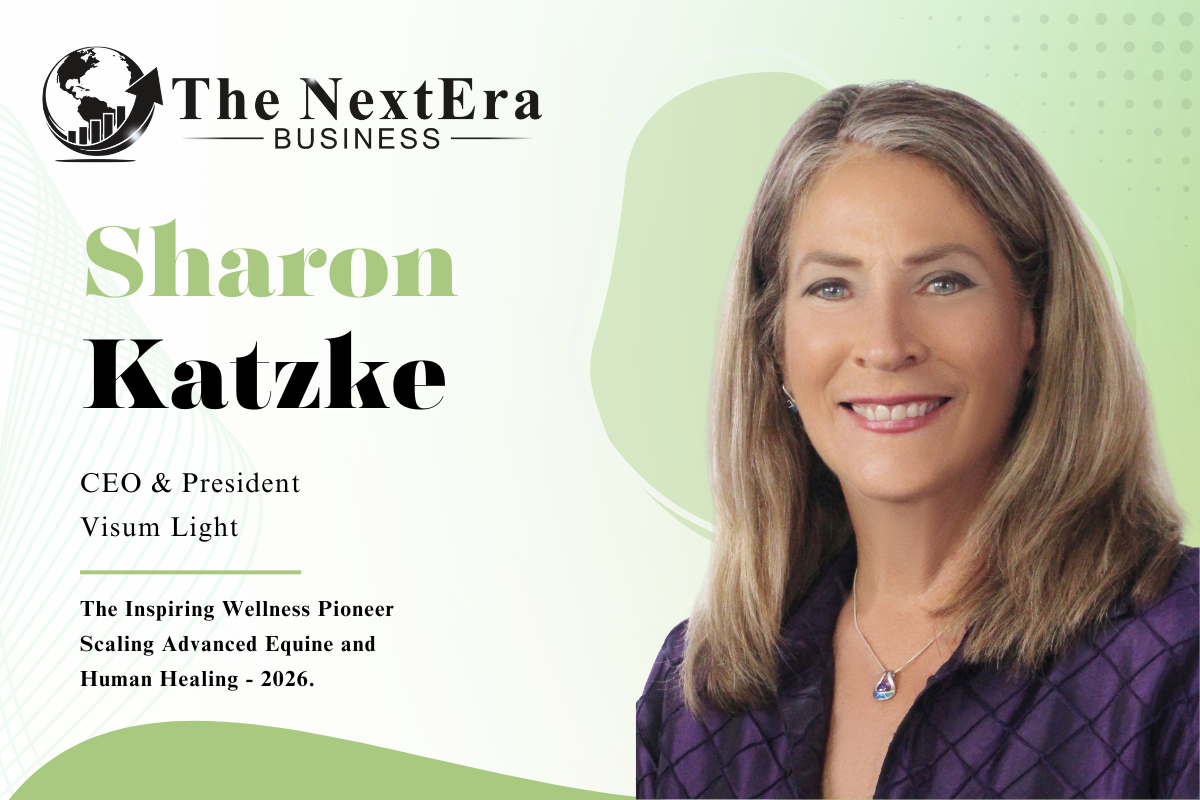
Sharon Katzke: Bringing the Power of Light Within Reach
Innovation often begins with a question. For Sharon Katzke, that question was simple yet
powerful: How could light therapy become practical enough for people to use consistently
and sophisticated enough to offer real versatility?
That question has guided her journey as an engineer, entrepreneur, innovator, and advocate
for accessible wellness technology. As the CEO and President of Visum Light, Sharon has
spent decades exploring the possibilities of photobiomodulation and developing technology
designed for professionals, animal practitioners, caregivers, and individuals who want to take
a more active role in supporting their own wellness.
Her work also extends through AAH Light, a complementary product line created for
customers who prefer a more straightforward approach to light therapy. Together, the two
brands reflect a philosophy that has remained central to Sharon's work from the beginning:
advanced technology should not be reserved for clinics, laboratories, or highly specialized
environments. It should be understandable, practical, and designed around the way people
actually live and work.
The journey that led Sharon into this field did not begin with a conventional business plan or
a calculated market opportunity. It began with an experience that made the potential of light
therapy impossible for her to ignore.
A demonstration involving a horse became the defining moment that changed the course of
her career.
Until then, light therapy was something she could learn about, research, and evaluate
intellectually. Watching an animal respond to a quiet, gentle, and non-invasive technology
created an entirely different level of understanding. Animals do not respond to marketing
campaigns, product promises, or preconceived expectations. They simply respond to what
they experience.
For Sharon, that moment raised new questions. How did the technology work? How could it
be improved? Could it become more versatile? Most importantly, could it be designed in a
way that made it easier for both professionals and everyday users to incorporate into their
routines?
Those questions eventually became the foundation for a career dedicated to advancing
practical light therapy.
A Vision Built Around Accessibility
Visum Light and AAH Light were created around a shared principle: people are more likely
to benefit from a wellness tool when they can understand it and use it consistently.
Visum Light represents the more advanced side of that vision. Its platform combines multiple
wavelengths, colors, programmed patterns, and Nogier frequencies within a portable system.
The goal was not simply to create another red-light device. Sharon wanted to develop a tool
with broader capabilities while keeping the experience practical for the person using it.
AAH Light was developed for a different type of customer. Its product family includes
individual-color handheld lights, red and near-infrared photobiomodulation products, and
Flex Pads. The approach is intentionally more straightforward.
Rather than assuming that every customer needs the same level of complexity, Sharon has
maintained two distinct product approaches. Some users want a highly versatile system with
multiple settings and programming options. Others prefer a focused device designed around a
specific color or function.
That distinction reflects one of the most important principles behind her leadership.
Technology should adapt to the needs of the user rather than forcing the user to adapt to
unnecessary complexity.
The companies were also built with a diverse customer community in mind. Their products
are used across different settings by healthcare practitioners, chiropractors, physical
therapists, veterinarians, equine professionals, horse owners, pet owners, caregivers, and
individuals supporting wellness at home.
This broad range of users has influenced both product design and education.
Sharon believes that access is an important part of inclusion. Wellness technology should not
exist only for large institutions or highly specialized practices. People come to light therapy
with different levels of training, resources, technical knowledge, and experience. Designing
products and educational resources that recognize those differences has become an important
part of the companies' approach.
Turning Curiosity Into Innovation
Sharon’s background as an engineer continues to influence the way she thinks about
innovation.
Engineering teaches discipline. It encourages people to question assumptions, test ideas,
identify weaknesses, and improve a design rather than accepting a claim simply because
someone says that something works.
That mindset has become deeply connected to her work in photobiomodulation.
However, entrepreneurship introduced another equally important lesson: technology must
solve a real problem for the person using it.
A technically impressive product is not automatically a useful product. If it is difficult to
operate, inconvenient to carry, awkward to position, or impossible to understand, even
sophisticated technology can fail to provide meaningful value.
Sharon’s leadership philosophy combines these two perspectives. She wants the technology
behind a product to be sound, but she also wants the product to make sense in real-world
situations.
This approach has led to a constant process of questioning.
Why does a product work this way? Could it work better? What are customers struggling
with? What does current research suggest? What happens when a device is independently
tested rather than evaluated only through manufacturer specifications?
These questions have shaped product development, programming, training materials, and
customer support.
For Sharon, innovation does not begin with the assumption that the next product must be
completely different. Sometimes innovation comes from listening carefully to the people
already using the technology.
Customers and practitioners can quickly identify what works and what does not. They can
explain what feels inconvenient, what they wish they could do differently, and where a design
could improve.
Many of the developments across the product portfolio have emerged from that process of
listening. More color options, improved programming, stronger batteries, hands-free formats,
independent testing, and expanded education all came from a willingness to ask how light
therapy could become more useful.
Building More Than a Basic Light
One of the central ideas behind Visum Light was versatility. Sharon questioned why users
should need multiple devices when different wavelengths, frequencies, and applications could
potentially be brought together within one portable system.
The Visum Hand-Held was developed around this vision. It combines red, blue, green, near-
infrared, and blended polychromatic color options within a single device. It also incorporates
structured pulsing, Nogier frequencies, and seven programmed patterns. The objective was to
create a practical and flexible experience. Users could select a color, work with a continuous
setting, use structured frequencies, or choose a programmed pattern without changing
equipment.
According to Sharon, Visum was the first to deliver this combination of technology, helping
establish a new standard for portable light therapy systems.
The Flex Pad line expanded this concept further. While a handheld device supports targeted
applications, larger areas often require broader coverage and hands-free use. The company
developed multiple Flex Pad configurations for areas such as the back, legs, joints, and other
larger regions. These systems can also be used in applications involving people, pets, and
horses.
This flexibility allows practitioners, veterinarians, equine professionals, and individual users
to incorporate the technology more easily into their routines. A Flex Pad can provide hands-
free coverage, while the handheld device supports focused applications.
For Sharon, however, the technology represents only part of the value. Education remains
equally important. As the product portfolio evolves, training helps users understand the
available colors, programs, frequencies, and formats, allowing them to engage with the
technology with greater confidence.
Meeting Skepticism With Education
Introducing light therapy into a market traditionally dominated by conventional medical
treatments presented Sharon with several challenges. The greatest was education. When she
first became involved with the technology, light therapy was far less understood than it is
today. Many people were skeptical, often questioning how a technology that appeared gentle,
simple, and non-invasive could involve sophisticated engineering and scientific principles.
Rather than responding to skepticism with arguments, Sharon focused on education. She
believed in explaining what the technology does, encouraging realistic expectations, and
helping people understand which specifications truly matter. Most importantly, she
encouraged customers to evaluate the technology for themselves.
This philosophy remains central today. The wellness market has become increasingly
crowded, with many products appearing similar despite significant differences in
performance and quality. Simply adding red LEDs to a device does not make every product
technologically equivalent.
Sharon emphasizes the value of scientific awareness, independent testing, and real-world
feedback. Research can reveal where photobiomodulation is heading, testing can demonstrate
what a device actually produces, and users can show whether it works effectively in everyday
life.
Balancing scientific understanding with practical usability has become a defining part of
Sharon’s approach to innovation, quality, and trust.
Trust as a Long-Term Investment
For Sharon, credibility cannot be created through exaggerated promises.
The wellness and health technology sectors face a significant challenge in separating genuine
innovation from marketing. Companies must remain responsible about the claims they make
because credibility can disappear quickly when promotion moves ahead of evidence.
Her strategy is based on transparency.
Tell customers what a product does. Explain what makes it different. Test what can be tested.
Avoid vague specifications. Do not promise outcomes that cannot be guaranteed.
Sharon also believes that an educated customer is better positioned to recognize the
difference between meaningful technology and marketing language.
This philosophy reflects her approach to photobiomodulation as a wellness technology. She
does not position light therapy as a replacement for appropriate medical or veterinary care.
Instead, she sees it as an additional tool that can be integrated alongside existing wellness
routines and professional care.
The appeal of the technology includes its non-invasive nature, portability, and relative ease of
integration. It does not require needles, a large treatment room, or complicated stationary
equipment.
At the same time, innovation requires responsibility.
Sharon recognizes how easy it can be in wellness marketing to take an interesting scientific
finding and turn it into a claim that goes far beyond what research supports. Her approach is
to distinguish between supporting normal biological processes and making claims related to
diagnosis, cure, or replacement of professional care.
That distinction becomes especially important when products are used across both human and
animal applications.
Innovation, in her view, should always include restraint.
A Company That Continues to Evolve
Visum Light’s growth did not come from one defining event.
Instead, trust developed gradually through continuous improvement, customer feedback,
education, testing, and word of mouth.
The company evolved from a basic light concept into a broader system featuring multiple
colors, near-infrared options, polychromatic selections, structured patterns, Nogier
frequencies, and both handheld and hands-free formats.
Practitioners and home users began sharing their experiences with others. Over time, those
conversations became an important source of growth.
Sharon attributes the company’s continued innovation to a refusal to assume that a product is
finished simply because it works.
Every product can raise another question.
Can the battery be improved? Could programming become more useful? Would additional
color options create more versatility? Could a hands-free format make the technology easier
to incorporate into everyday use? What can independent testing reveal? How can educational
materials become clearer?
The expansion of the Flex Pad line represents one important example of this mindset.
Customers wanted larger coverage areas and greater freedom during use. The company
responded by developing different configurations for practical applications across people and
animals.
At the same time, the business continued expanding its educational efforts. Sharon sees the
relationship between technology and knowledge as inseparable. A device can offer extensive
capabilities, but users still need to understand how to navigate its different options.
Continuous learning therefore remains central to the organization.
The science of photobiomodulation continues to evolve. New research, emerging
technologies, customer experiences, and practical testing all contribute to the company’s
ongoing development.
Leadership Guided by Curiosity
Looking back across her career, Sharon identifies curiosity as one of the strongest forces
behind her journey. Light therapy appealed to two sides of her personality. She wanted to
understand how the technology worked, but she also wanted to explore how it could help
people and animals feel better. Once she recognized its potential, simply selling an existing
product was not enough. She wanted to improve the technology, make it easier to use, and
continue learning.
That curiosity continues to guide her today. Sharon reads, researches, listens to practitioners,
speaks with customers, evaluates new developments, and questions her own assumptions. She
believes some of the most valuable ideas come from the people who use a product every day.
This willingness to listen has become an important leadership strength. Her mission also
reflects a belief that people should play a more active role in their own wellness through
education, tools, and confidence.
The same mindset shapes the culture around Visum Light. Innovation begins with questions,
but progress requires persistence. Sharon has learned that skepticism is inevitable when
introducing new ideas. Rather than taking it personally, she continues educating, improving,
and listening. Over time, one lesson has remained clear: credibility is built slowly and can be
lost quickly.
The Responsibility of Building in Wellness
For aspiring entrepreneurs looking to combine technology, healthcare, and meaningful
impact, Sharon offers clear advice: start by solving a real problem. Rather than beginning
with a product, begin with the people you want to help. Listen carefully, understand their
needs, and build solutions around challenges that genuinely matter.
She also emphasizes an unwavering commitment to quality. In healthcare and wellness, trust
cannot be built on hype alone. A strong reputation is earned through consistency,
responsibility, and real results.
Setbacks are also part of the entrepreneurial journey. New ideas may fail, designs may need
revision, and assumptions may prove wrong. What matters is how quickly you learn, adapt,
and move forward.
Sharon's journey reflects this mindset. Her success developed through years of questioning,
testing, refining, educating, and continuing despite skepticism. As she says, “Success is rarely
a straight line.” She also believes that “Where there is a will there is a way.”
Above all, Sharon values courage. “Courage is moving forward before you have every
answer.” For innovators, waiting for complete certainty may mean never beginning at all.
A Legacy of Making Light Therapy Practical
Among the many experiences Sharon Katzke has witnessed throughout her career, some of
the most meaningful have involved animals. These moments continue to remind her of the
horse that first introduced her to the possibilities of light therapy and ultimately set her on an
unexpected professional journey.
When an owner shares that an animal once uncomfortable, anxious, or difficult to settle
begins to relax during a light session, those experiences hold special meaning for Sharon.
Animals cannot explain their expectations or describe what they hope to feel. Their responses
are immediate, natural, and authentic. For Sharon, these stories represent far more than
customer feedback. They reconnect her with the curiosity that started everything.
That same curiosity continues to guide her work as CEO and President of Visum Light. Her
goal has always been to help make light therapy more practical, understandable, and
accessible to a wider community. She believes sophisticated technology does not need to be
complicated for the people who use it. Multiple wavelengths, frequencies, programming, and
thoughtful engineering can work together while remaining simple and approachable.
Sharon hopes Visum Light will contribute to a broader understanding of light therapy as a
practical wellness tool rather than something unusual or inaccessible. Her journey reflects the
belief that meaningful progress often begins with a question, a demonstration, and the
willingness to explore unfamiliar possibilities.
Her philosophy remains simple: “If you can dream it, you can do it.” And for those willing to
pursue ambitious ideas despite uncertainty, she offers another reminder: “If you get in the
saddle, be ready for the ride.”
From one horse to a lifelong journey of innovation, Sharon Katzke continues to explore what
more may be possible.