

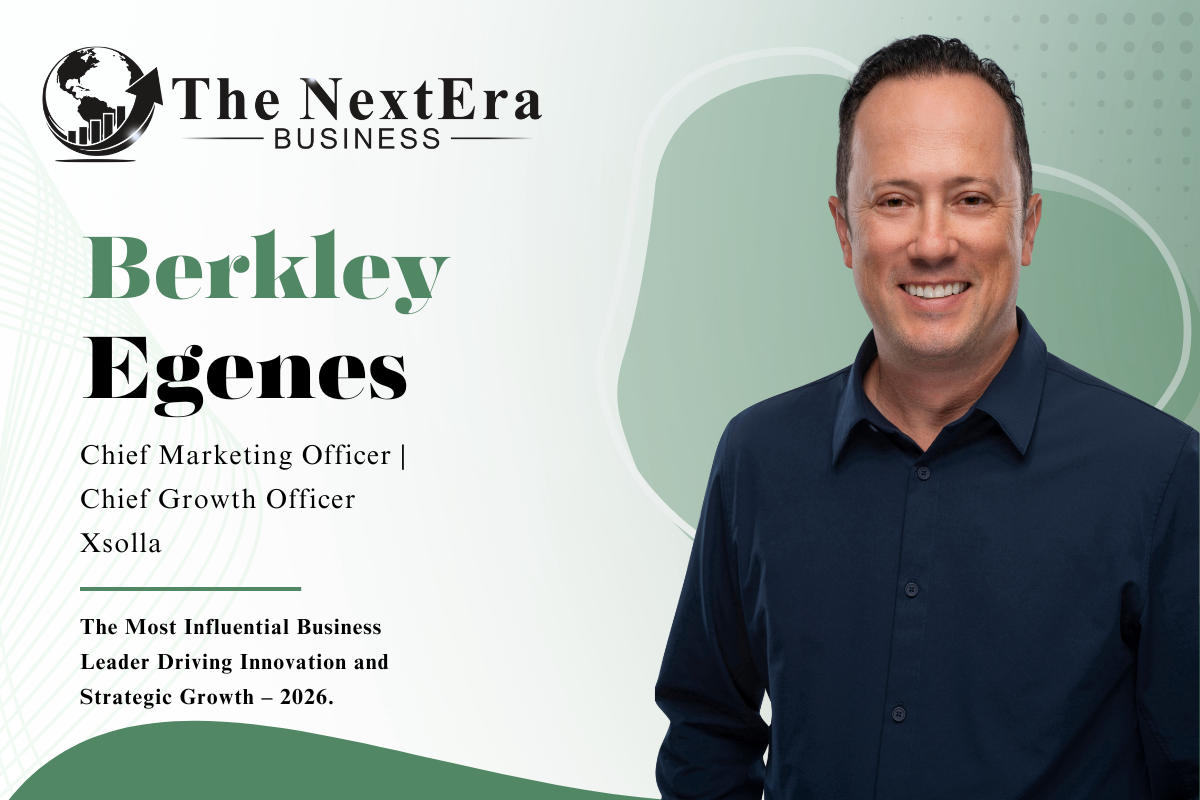
Berkley Egenes: Redefining Growth at the Intersection of Marketing, Gaming, and Technology
What happens when the audience is no longer willing to sit quietly on the other side of the
screen?
That question increasingly defines the business of gaming. Players do not simply buy a game and
walk away. They discuss it, stream it, modify it, critique it, build communities around it, follow
creators who influence how they discover it, and decide for themselves whether a brand has
earned their attention.
In such an environment, marketing cannot remain a campaign that begins with an announcement
and ends with a report. It has to become part of the experience itself.
Few marketing leaders understand that shift as deeply as Berkley Egenes, Chief Marketing &
Growth Officer at Xsolla. With more than two decades of experience spanning consumer
brands, technology, sports, entertainment, and gaming, Berkley has built a career around
understanding how people connect with businesses and, increasingly, how businesses can earn
the right to remain part of those relationships.
His professional journey has included global names such as Kellogg’s, AB InBev, NASCAR,
IBM, Walmart, and CVS, followed by his work helping build the Ghost Gaming esports brand.
He joined Xsolla in 2020 as Vice President of Global Marketing, became Chief Marketing
Officer in 2022, and has since expanded his mandate to include growth.
Today, that experience converges at a particularly important moment for gaming. Xsolla operates
across the complex intersection of commerce, payments, technology, player engagement, and
global game distribution. The company supports more than 1,000 payment methods across 200+
geographies and reports more than 3,000 direct-to-consumer shops launched. Its platform
processed 180.5 million average daily developer API calls, according to the company’s current
figures.
For Berkley, however, the numbers are only useful when they illuminate something human.
A Career Built Around Connection
Berkley’s understanding of growth was not shaped by a single industry. It was accumulated
through different environments, business models, audiences, and challenges.
His early experience with Kellogg’s and AB InBev reinforced the fundamentals of consumer
insight, brand building, and disciplined execution at scale. Work with NASCAR, IBM, Walmart,
and CVS demonstrated how technology, partnerships, and customer experience could transform
large organizations. His move into esports introduced another dimension: community.
That experience eventually brought him to Xsolla, where technology, entertainment, commerce,
and marketing intersect.
The lesson Berkley carried across each transition was deceptively simple: sustainable growth
begins with understanding the customer, the product, and the economics of the business.
It is a philosophy that explains why he does not see marketing as an isolated department. At
Xsolla, brand and growth are expected to speak to each other. A campaign needs a narrative, but
it also needs a measurable reason to exist.
“Data is a compass, not a script,” Berkley explains.
The distinction matters. Data can identify friction, opportunities, behavior patterns, and
performance. It cannot, by itself, produce an idea worth remembering. For Berkley, creativity
enters precisely where analytics stop being sufficient. His approach is to test bold ideas,
understand what resonates, and refine the work without stripping away the human quality that
made it compelling in the first place.
The best campaigns, in his view, begin with insight rather than a spreadsheet.
Marketing To People Who Participate
Gaming changed the equation.
Traditional consumer marketing often assumes an audience that receives a message. Interactive
entertainment has a fundamentally different relationship with its audience because players
participate in the product itself. They form communities around games, create content, respond
to updates, influence other players, and remain connected long after launch.
That makes gaming marketing less about interrupting attention and more about earning
participation.
Berkley was drawn to the industry precisely because it combines creativity, technology,
storytelling, and rapidly changing consumer behavior. Games have evolved into platforms and
communities with global audiences, and the marketing journey continues through live services,
creators, social platforms, updates, and cultural moments.
This shift has changed the relationship between developers, publishers, platforms, brands, and
players. Players now have considerably more influence through social media, creators, feedback,
and communities. Developers and publishers can communicate with audiences throughout a
game’s lifecycle rather than treating launch day as the finish line.
For marketers, that means the old one-way model is becoming increasingly inadequate.
The question is no longer simply, “How do we reach the player?”
It is, “Why would the player want us there?”
Berkley’s answer begins with listening.
His experience in esports reinforced the lesson. Gaming communities quickly recognize when a
brand is trying too hard to manufacture relevance. Authenticity cannot be purchased through a
clever campaign. It develops through consistency, meaningful participation, support for creators
and developers, and a clear understanding of the brand’s role within the ecosystem.
That philosophy also informs how Berkley approaches partnerships.
Partnerships That Have A Reason To Exist
A famous name does not automatically make a valuable partnership.
Berkley starts with the audience and the purpose of the collaboration rather than the celebrity
attached to it. He looks for cultural overlap, shared values, credibility within gaming, and a
meaningful role for every participant.
The objective is to create something that could not have existed in quite the same way without
the partnership.
That could mean an experience, a new commercial opportunity, community engagement, or a
stronger connection between audiences. The measure of success is not simply visibility. Berkley
looks for relevance that can survive beyond a single campaign and produce measurable outcomes
over time.
The same principle applies when choosing between brands, creators, athletes, entertainers, and
gaming talent. Reach matters, but so does credibility. A partner needs to bring something
distinctive while remaining natural to its existing audience.
The strongest partnerships, Berkley believes, create more than the sum of their individual parts.
That is particularly important as gaming increasingly converges with sports, music,
entertainment, and social media. The boundaries between these categories are becoming less
meaningful because audiences themselves move fluidly between them.
For businesses, this creates enormous opportunity. It also creates a greater responsibility to
understand culture before attempting to enter it.
Commerce Should Strengthen The Relationship
Xsolla’s position in this changing ecosystem gives Berkley a broader lens through which to think
about marketing.
Commerce is often treated as the moment when marketing ends, and a transaction begins.
Berkley sees it differently.
A good commerce experience can become another point of connection between a game and its
players. Secure checkout, transparent pricing, local payment methods, relevant offers,
subscriptions, gifting, and loyalty experiences can make participation easier rather than
interrupting it.
That thinking is central to Xsolla’s growing emphasis on direct-to-consumer commerce.
Web shops give developers and publishers greater ownership of the player relationship. Instead
of relying entirely on third-party platforms, studios can create direct channels for engagement,
gain first-party insights, develop loyalty programs, personalize offers, and build commerce
experiences around their communities.
The opportunity is therefore larger than selling another digital item.
It is about knowing the audience better.
Xsolla currently positions its Web Shop as part of a broader D2C ecosystem, connecting
commerce with engagement, LiveOps, payments, and player data. The company says its Web
Shop powers more than 800 mobile game D2C experiences.
For Berkley, this evolution reflects a larger change in how companies should think about
customer relationships. The transaction is not the destination. It is one moment within a much
longer relationship.
Personalization without Losing Trust
More data creates more possibilities. It also creates more responsibility.
Personalization can make marketing more relevant by allowing brands to understand preferences,
behaviors, and engagement patterns. But Berkley is careful about where that responsibility
begins.
Players should know what information is being collected and why. Consent matters. Security
matters. So does restraint.
The objective is not to use every available piece of data simply because it exists. It is to use
information to create something genuinely useful for the player.
That distinction is increasingly important as AI and advanced analytics become more deeply
embedded in gaming. The technology may allow companies to predict behavior and personalize
experiences with unprecedented precision, but precision without trust can quickly become
intrusive.
Berkley's philosophy is therefore player-focused rather than transaction-focused. When
personalization is relevant and respectful, it can strengthen loyalty. When it becomes excessive,
it can damage the very relationship it was intended to improve.
Global Reach, Local Relevance
Gaming is global by nature, but audiences do not experience culture globally in the same way.
A campaign can carry one strategic idea across markets without looking identical in every
market. Berkley believes the strongest global marketing establishes a consistent brand platform
while giving local teams enough freedom to make the idea culturally relevant.
That means local language, creators, communities, gaming behavior, and cultural context need to
be considered early.
Translation alone is not localization.
A regional creator may understand a community in a way a global campaign team never could. A
local partnership can give a brand credibility that no amount of media spending can manufacture.
Xsolla’s own scale makes this particularly relevant. Its commerce infrastructure currently spans
more than 200 geographies, with more than 1,000 payment methods and support across multiple
currencies and languages.
For Berkley, global growth therefore cannot mean simply taking one campaign and reproducing
it everywhere. It means knowing which parts of the brand must remain consistent and which
parts should breathe differently in different cultures.
Growth That Can Be Measured
Berkley’s approach to growth ultimately returns to accountability.
At Xsolla, brand storytelling and performance are not competing priorities. The company begins
with a clear narrative around the problem it solves for developers and publishers, then connects
that narrative to measurable objectives.
Pipeline growth can matter. Platform adoption can matter. Partner retention can matter.
The important point is that storytelling establishes the emotional connection while metrics
provide discipline. Shared KPIs and constant iteration allow global teams to learn rather than
simply report.
That mindset is visible in Xsolla’s broader product evolution. The company has responded to
market needs with initiatives such as Xsolla Web Shop, while its funding initiatives connect
developers with investors and publishers. Xsolla Funding currently connects developers with a
network of more than 250 investors and publishers.
The underlying principle remains consistent: understand the problem, create a useful solution,
test it, listen, and improve.
The Brand Of Tomorrow Will Have To Listen
Berkley believes the next phase of gaming will be increasingly connected, personalized, and
community-driven.
Marketing will move further toward creators, communities, live experiences, and cultural
moments. Monetization will continue to develop through D2C models, subscriptions, digital
goods, loyalty, and personalized commerce. AI will influence how games are created, marketed,
and experienced.
But beneath all the technology, Berkley sees a more fundamental shift.
Players will increasingly be treated as participants rather than consumers.
That distinction could define the next era of interactive entertainment.
Xsolla’s 2026 platform strategy reflects this direction. At GDC 2026, the company presented a
reimagined platform vision centered on helping developers own more of their audience
relationships, data, and revenue, with direct-to-consumer commerce, intelligent payments, and
player engagement at the core. Berkley described the industry’s direction as one in which success
is increasingly tied to ownership and sustainable player relationships.
It is a natural progression of the philosophy he has developed throughout his career.
Technology will change. Platforms will change. Consumer behavior will change. The strongest
marketing leaders will be the ones capable of changing with them without losing sight of the
people behind the data.
The Legacy Of Making Marketing Matter
For Berkley, the ambition extends beyond campaigns.
He wants to demonstrate that marketing can drive commercial growth while contributing
meaningfully to the culture and communities surrounding gaming. The experiences worth
remembering are not necessarily the ones with the largest advertising budgets. They are the ones
that gave people something of value.
That philosophy also defines his advice to the next generation of marketing leaders.
“Stay curious. Listen carefully. Remain adaptable.
Most importantly, understand people.”
After more than two decades across some of the world’s most recognizable consumer,
technology, sports, and entertainment businesses, Berkley has seen enough change to know that
no strategy remains perfect forever. Resilience matters because markets move. Adaptability
matters because audiences evolve. Leadership matters because talented teams need the freedom
to experiment while remaining accountable for what they create.
Perhaps that is what makes Berkley's approach particularly relevant to the next chapter of
gaming.
He is not treating marketing as a louder way to sell. He is treating it as a way to understand.
At Xsolla, that understanding is being translated into commerce infrastructure, direct
relationships, global expansion, partnerships, personalization, and new ways for developers to
build sustainable businesses. The ambition is not simply to help games find players. It is to help
create an ecosystem in which developers can understand those players, serve them better, and
build relationships that last.
In an industry where technology changes almost as quickly as culture, that may be the most
durable growth strategy of all.