
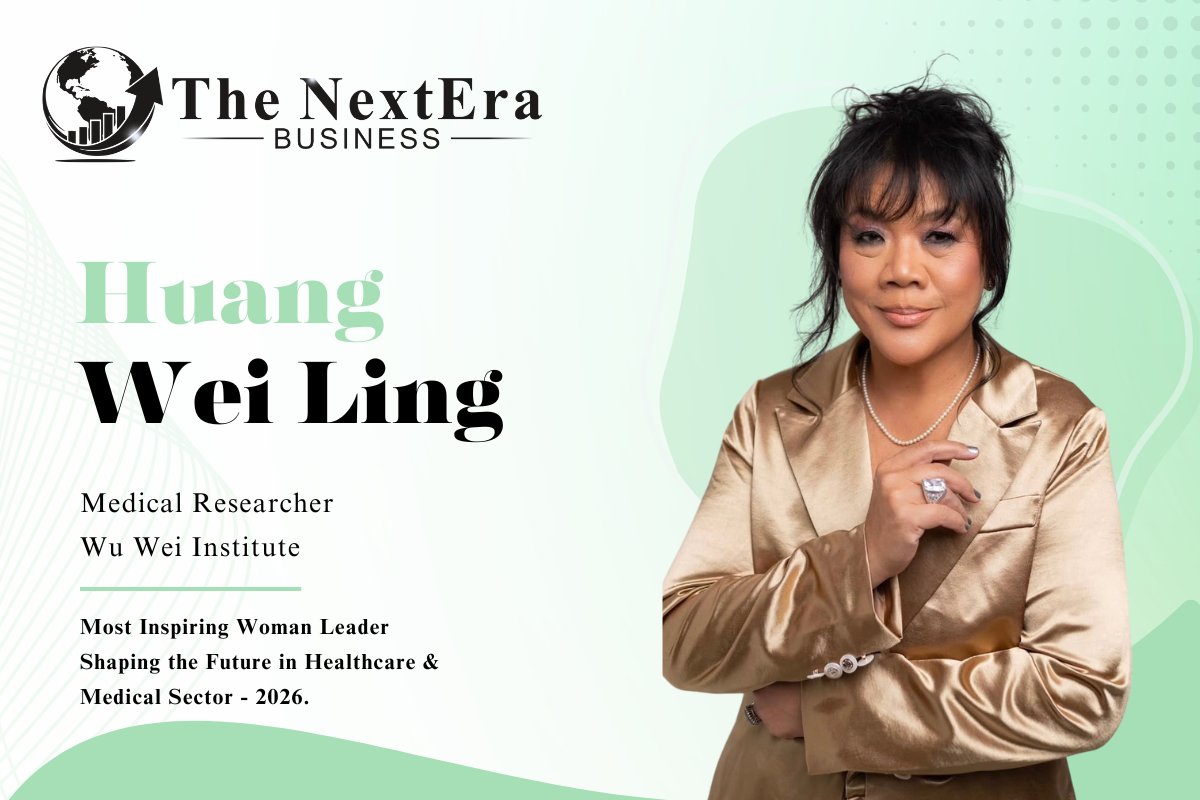
Huang Wei Ling: Reimagining Healthcare Through Integration, Inquiry, and the Courage to Look Deeper
Healthcare has never been a field that stands still. As medicine advances, new technologies emerge,
research expands, and physicians gain access to more sophisticated tools for diagnosis and treatment.
Yet one question continues to challenge the healthcare community: how can medicine better
understand the whole person rather than focusing only on the symptoms of a disease?
For Huang Wei Ling, MD, this question has shaped more than three decades of clinical practice,
research, education, and professional development. Her career reflects a persistent belief that
healthcare can benefit from broader perspectives, deeper investigation, and meaningful dialogue
between different medical traditions.
After graduating from medical school 34 years ago, Dr. Huang embarked on a journey that would
eventually lead her beyond the conventional boundaries of medical practice. Her work brought
together Traditional Chinese Medicine, acupuncture, homeopathy, clinical observation, research, and
an approach she developed known as the Wu Wei Protocol.
Today, through the Wu Wei Institute, her mission centers on advancing an integrative approach to
healthcare and exploring what she describes as deeper energetic factors associated with disease. Her
work has also extended into scientific publishing and international education. Since beginning her
scientific publishing journey in 2018, she has written approximately 300 articles exploring energetic
causes that, within her clinical framework, may contribute to symptoms across different medical
specialties.
At the heart of her philosophy is a simple but challenging idea: understanding illness may require
looking beyond the disease itself.
From Clinical Questions to a New Therapeutic Framework
The origins of the Wu Wei Protocol can be traced to Dr. Huang’s decision to study homeopathy in
2015 at the Lamasson Institute in Ribeirão Preto, Brazil. The course required her to complete a
monograph, but the academic exercise became the starting point for a much larger intellectual
journey.
During her studies, she felt that certain aspects of classical homeopathic reasoning left questions
unanswered. In her view, selecting one medicine from thousands of possibilities could depend heavily
on memorization and symptom interpretation. Her existing knowledge of Traditional Chinese
Medicine gave her another way to examine the problem.
Rather than viewing each medicine only through its traditional indications, she began interpreting
medicines according to what she considered their energetic pathways. This led her to formulate a
different theoretical approach.
Her reasoning worked backward from the symptoms toward what she regarded as the root of a
patient’s condition, including deeper factors and external pathogenic influences. Instead of considering
approximately 6,000 medicines available within the broader therapeutic system developed by Samuel
Hahnemann, her approach narrowed the selection to a smaller group, generally five to ten medicines,
according to the clinical framework she developed.
This became the foundation of the Wu Wei Protocol.
approximately 6,000 medicines available within the broader therapeutic system developed by Samuel
Hahnemann, her approach narrowed the selection to a smaller group, generally five to ten medicines,
according to the clinical framework she developed.
This became the foundation of the Wu Wei Protocol.
Research as a Path to Questions, Not Just Answers
Dr. Huang’s scientific publishing journey began in 2018 with an article examining the treatment of
low back pain using auricular acupuncture alone. In that work, she applied principles of Traditional
Chinese Medicine and used auricular points to address deficiencies in organs that, within her clinical
framework, she associates with what she describes as a New Global Immunodeficiency.
She reported improvements in all patients included in the study, including patients with herniated
discs who had previously received an indication for surgery. She also presented the study orally at an
American Academy of Medical Acupuncture conference in San Diego, California.
The experience opened a new chapter.
The arrival of COVID-19 accelerated that commitment to research and international knowledge-
sharing. As healthcare professionals around the world tried to understand a rapidly changing clinical
environment, Dr. Huang began publishing a series of articles based on her clinical observations and
therapeutic perspective.
During the pandemic, she advocated within her approach for highly diluted medicines rather than
highly concentrated medicines, antipyretics, or antibiotics in certain contexts. She explained her
reasoning through scientific publications and numerous online presentations.
The limitations imposed by lockdowns also changed the way she communicated. International travel
and traditional conferences became difficult or impossible, making virtual conferences an essential
platform for professional exchange.
For Dr. Huang, the transition demonstrated that geographical distance did not have to prevent
knowledge-sharing. Physicians, researchers, and educators could continue exchanging ideas across
borders through digital platforms.
Her body of published work has since grown to approximately 300 articles. These publications
explore what she describes as energetic causes that may underlie symptoms appearing across different
medical specialties. Her research philosophy is rooted in the belief that medicine should remain curious. Scientific
inquiry, from her perspective, should encourage professionals to investigate connections between
seemingly different conditions and remain open to questions that may not fit neatly within
conventional categories.
Building a Bridge Between Medical Traditions
The Wu Wei Institute represents the institutional expression of this philosophy.
Its mission is centered on people who continue to experience health problems despite conventional
treatment and on developing an approach that seeks to consider the individual as an integrated whole.
For Dr. Huang, the future of healthcare depends partly on building bridges rather than creating
divisions between medical traditions. Traditional Chinese Medicine and Western medicine have
developed through different historical and intellectual pathways, but she believes they can contribute
complementary perspectives when approached responsibly.
That integration requires more than simply combining techniques. It requires practitioners to
understand the reasoning behind different approaches, evaluate available evidence, remain within
applicable professional frameworks, and continue learning.
Her own experience in Brazil reinforced the importance of this balance. While developing her theory,
she considered the country's regulatory environment and chose to work with medicines already
authorized for use there. This allowed her to apply a therapeutic rationale informed by Traditional
Chinese Medicine without depending on Chinese herbal medicines that were more difficult to obtain
within the Brazilian context.
For Dr. Huang, appropriate regulation matters. She believes practices such as acupuncture and
homeopathy should have clear recognition and regulatory frameworks as medical specialties, allowing
physicians to use appropriate approaches within established standards.
Her position reflects a broader principle that has guided her career: innovation in healthcare must exist
alongside professional responsibility.
A Vision for the Next Decade
Dr. Huang does not describe the future of integrative medicine as an easy transformation. She sees a
long road ahead, one that requires physicians and healthcare professionals to explain their ideas
clearly, continue studying, engage in meaningful dialogue, and gradually introduce perspectives that
could contribute to better outcomes.
Her concern extends beyond individual diseases to the way healthcare systems conceptualize patients.
A physician can become a patient. A doctor may develop cancer, diabetes, or experience a heart attack
and receive appropriate treatment, while questions about the broader factors that contributed to the
condition may remain less explored.
Dr. Huang views this not as an individual failure, but as a limitation of a system that can encourage
professionals to focus on one part of a much larger picture. Her vision is therefore based on expanding the conversation.
She believes change can develop through a domino effect as more physicians become interested in
concepts that have received less attention in traditional medical education. Over time, broader
perspectives could influence how future healthcare professionals understand prevention, chronic
disease, and patient care.
The institute’s aspiration is ambitious. By 2030, Dr. Huang hopes to make what she describes as her
energy-replenishment approach accessible to a significant part of the global population, with the
broader objective of promoting health and reducing the burden of disease.
Leadership Through Humility and Continuous Learning
Behind Dr. Huang’s professional journey lies a leadership philosophy built less on authority and more
on curiosity, resilience, and humility.
She believes that challenges are not necessarily negative experiences. Instead, they can become
opportunities for learning. Her response to difficult situations has been to search for alternatives rather
than conclude that there is no solution.
This mindset has helped her navigate professional skepticism, regulatory considerations, academic
challenges, and the complexities of introducing ideas that differ from established approaches.
She also places considerable importance on language and perspective. Words such as “there is no way
out” or “there is no solution,” she believes, can limit the way people approach problems. By
maintaining a constructive mindset, she seeks to identify possibilities even when circumstances
appear difficult.
Her leadership philosophy is equally connected to humility.
Dr. Huang emphasizes that no healthcare professional can know everything. The ability to recognize
what remains unknown is, in her view, a strength rather than a weakness.
“I did not know them either, and I continue learning every day,” is the principle behind her approach
to collaboration.
This belief becomes particularly important in interdisciplinary healthcare. Modern medicine is too
complex for any individual specialty to possess every answer. Physicians, researchers, educators, and
practitioners must be willing to listen to one another and recognize when another discipline can
provide clarity.
She describes professionals as being “in the same boat,” even if some may be navigating slightly
ahead in particular areas because of their research or clinical experience.
The essential quality, she believes, is the willingness to keep learning.
Global Knowledge-Sharing in a Connected Healthcare World
International collaboration has become an important component of Dr. Huang’s work.
Her conference presentations, scientific publications, and online educational activities have allowed
her ideas to reach audiences beyond her immediate clinical environment. The COVID-19 pandemic,
despite its enormous disruption, accelerated the adoption of virtual conferences and created new
opportunities for global communication.
For Dr. Huang, this experience reinforced the importance of sharing knowledge rather than working
in isolation.
Healthcare professionals can learn from different specialties, different countries, and different
intellectual traditions. Such exchanges can expose practitioners to questions they may not encounter
within their own fields.
The objective, in her view, is not to claim that one approach has every answer. It is to create an
environment where professionals can investigate, question, test, discuss, and continue developing
their understanding.
That spirit of collaboration is also central to the institute’s educational direction, where practitioner
learning, clinical practice, and research must continue to inform one another.
Personal Purpose Behind a Professional Mission
Although Dr. Huang’s career has been shaped by medicine and research, her personal philosophy is
equally important to the way she approaches leadership.
She believes that when work is driven by genuine commitment and purpose, even a difficult mission
can be sustained.
When she began her career, she could not have known exactly where the journey would lead. Over the
decades, however, each stage of clinical practice, research, education, and professional development
contributed to the direction she follows today.
Her faith in God has remained a constant foundation throughout that journey. She sees her work as
part of a greater purpose and believes she has a responsibility to protect human life and well-being.
That sense of purpose also informs her personal brand. She has never been particularly interested in
simply following the path taken by everyone else. Her instinct has been to question, explore, and
consider alternative perspectives.
For her, personal branding is therefore not primarily about visibility. It is about consistency between
values, actions, and mission.
Her work reflects a physician who wants to investigate unanswered questions while remaining
committed to the people she serves.
Inspiring the Next Generation of Women Leaders
For women aspiring to become influential leaders in healthcare, scientific research, and innovation,
Dr. Huang emphasizes intellectual openness. She draws inspiration from a principle widely attributed to Albert Einstein: problems cannot be solved
through the same thinking that created them.
For her, the message is particularly relevant to healthcare. Complex problems may require knowledge
from outside traditional boundaries. A physician who remains open to other disciplines may discover
perspectives that change how a problem is understood.
She also refers to Hippocrates and the idea that one lifetime is not enough to learn everything there is
to know.
This belief captures the leadership model she advocates: curiosity without arrogance, ambition
without losing humility, and innovation supported by continuous education.
Influence, in her view, should not be measured simply by recognition. It should be measured by the
ability to contribute something meaningful to patients, colleagues, and future generations.
Recognition as a Beginning, Not an Endpoint
Being recognized among the Most Inspiring Woman Leaders Shaping the Future in Healthcare &
Medical Sector 2026 is meaningful to Dr. Huang because it reflects work carried out over 34 years
since her graduation from medical school.
Yet she does not view recognition as the destination.
For her, it represents the beginning of a longer journey.
The next stage involves continuing to explore how healthcare education can evolve, including the
possibility of revisiting medical-school curricula and incorporating areas of knowledge that can help
physicians understand human beings as integrated wholes rather than collections of isolated systems.
Her message to aspiring healthcare innovators is straightforward: remain humble, remain curious, and
remain committed to the patient.
Innovation requires the courage to question established assumptions, but it also requires discipline.
New ideas must be studied, communicated responsibly, evaluated carefully, and translated into
appropriate care.
That balance between curiosity and responsibility defines Dr. Huang’s continuing journey.
Through the Wu Wei Institute, her research, clinical experience, education, and international
knowledge-sharing, she continues to pursue a vision of healthcare that looks beyond conventional
boundaries. Whether every element of her theoretical framework ultimately gains wider scientific
acceptance remains a matter for ongoing research and rigorous evaluation. What is unmistakable,
however, is the persistence behind her questions and her commitment to exploring them.
Her story is ultimately about the courage to look deeper.
It is about recognizing that medicine is continually evolving, that unanswered questions deserve
investigation, and that meaningful progress often begins when professionals are willing to reconsider
what they think they already know. For Dr. Huang Wei Ling, the future of healthcare will depend not only on new technologies or
treatments, but also on the willingness of physicians to keep learning, collaborate across disciplines,
and see the patient as more than a diagnosis.
That journey, she believes, has only just begun.