

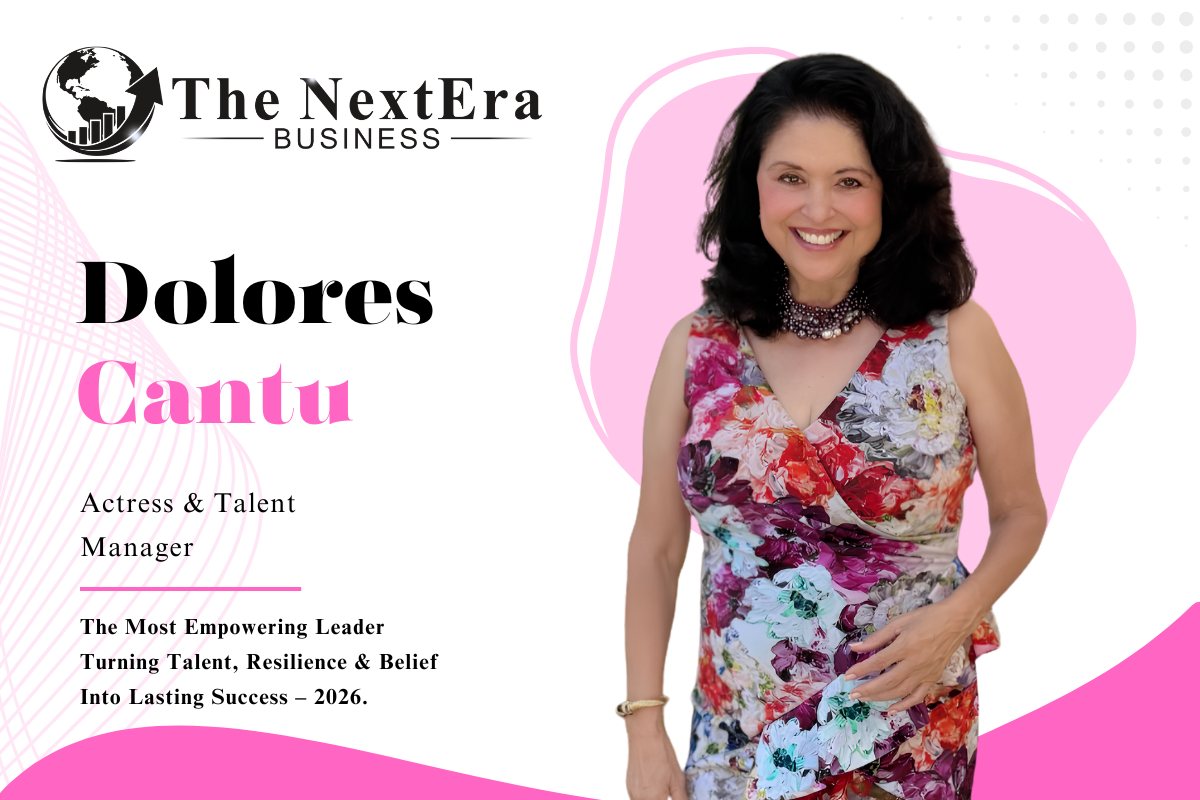
The Woman Who Never Stopped Dreaming Dolores Cantu, Actress & Talent Manager
What does it take to build a life in an industry that repeatedly tells you who you are supposed to
be?
For some, the answer might be talent. For others, opportunity, luck, connections, or timing. For Dolores Cantu, it has always been something more elemental: the decision to keep believing in yourself when there is very little evidence that anyone else does. That belief has carried Dolores through more than five decades in entertainment. It began long before Hollywood, in a childhood shaped by discrimination and the experience of growing up Mexican American at a time when being different often meant being told, directly or indirectly, that you did not belong. It followed her through a movie theater job at 14, an unexpected beauty-pageant title at an
insurance company, the independence of becoming an Eastern Airlines stewardess, the national stage of Miss USA and Miss Universe, the challenges of becoming a Latina actress, years of entrepreneurship and television, and eventually the creation of Candu Management. Today, Dolores is an actress, talent manager, entrepreneur, influencer, mentor, and trailblazer. But perhaps the simplest description is the one she gives herself: a relentless advocate, a tireless cheerleader, and a believer in the potential of others. Her story is not simply about making it in Hollywood. It is about making the road easier for someone else.
The First Lesson in Leadership
Dolores learned about leadership before she had a word for it. At 14, she began working at a local movie theater. She loved the theater because it offered more
than employment. Sitting among movies and stories, she could imagine a bigger life for herself. She started as one of the " popcorn girls." Before long, Dolores had effectively made herself the manager. The experience gave her an early glimpse of something that would become a defining quality throughout her life: when Dolores sees an opportunity, she does not wait around for someone to tell her that she is ready. She steps forward. Later, while working for Prudential Insurance, she was selected as "Miss Debit Clerk" because of her work ethic, personality, and ability to connect with people. Dolores laughs at the irony of having her first beauty-pageant experience at an insurance company, but she remembers the deeper lesson clearly. Work hard. Learn. Take the opportunity in front of you. Let each
experience build your confidence. For Dolores, leadership never began with a title. It began with behavior. That belief would soon take her somewhere very different.
From a Local Theater to the National Stage
In 1970, Dolores became a stewardess for Eastern Airlines. For many young women at the time, becoming a stewardess represented independence and freedom. For Dolores, it meant something deeply personal too. She opened her own checking account and experienced financial independence for the first time. But her role soon became larger than flying. There were very few Latina stewardesses at the time, and Eastern Airlines recognized something distinctive in Dolores. She could connect with Hispanic audiences in a way few representatives could. The company began using her as an ambassador to promote new routes and destinations, particularly as it expanded into Mexico, Latin America, and South America. In 1972, she represented Eastern Airlines as Miss Hospitality at the Miss USA and Miss Universe pageants.
The experience gave Dolores training that would later prove invaluable in entertainment. Eastern helped her develop skills in public speaking, etiquette, presentation, and the ability to command a room.
More importantly, people at Eastern saw something in her. A young woman with a big personality, a big smile, and a determination to succeed. That experience shaped the manager Dolores would eventually become. She learned what it felt like when someone else recognized potential in her before she had fully recognized it herself.
Decades later, she would return that gift to others.
When Confidence Became a Form of Resistance
Dolores’ journey cannot be understood without understanding what she had to overcome.
She grew up Mexican American in an environment where discrimination was part of everyday life. Spanish was the primary language in her home, and she struggled with English as a child. She remembers being called deeply offensive names intended to make her feel inferior and remind her that, in the eyes of some people, she did not belong.
But Dolores made an early decision.
Other people’s opinions would not become the measure of her worth. That decision became one of the most important forms of resilience in her life.
When Dolores eventually entered Hollywood, she encountered another version of the same barrier. Opportunities for Hispanic performers were limited, and representation was far from what it is today. Instead of accepting that reality as permanent, Dolores became part of the effort to change it. She became involved with Nosotros, the organization founded by Ricardo Montalbán, and helped produce showcases that created opportunities for Latino actors. Representation, for Dolores, therefore became more than seeing someone who looked like her on a screen. It became the possibility of someone else looking at her and thinking: If she could do it, maybe I can do it too. That is the power she believes representation carries
Hollywood Did Not Always Say Yes
Every successful career contains moments that do not make it into the résumé.
For Dolores, one of those moments came after moving to Los Angeles. She was told that there were no jobs for Mexicans and that she should return to New York, where she had previously been working. There are moments when a person’s future can be altered by a single sentence. Dolores chose not to accept that sentence. She essentially told the agent, “I’m a booker. Give me a chance.” Eventually, the chance came. Dolores went on to book hundreds of commercials, print jobs, television appearances, and films. The experience became one of the clearest lessons of her life. Rejection is about a moment. It is not a verdict on a person’s talent. It does not define their future. And it certainly does not determine their worth. That distinction now forms a major part of Dolores’ relationship with the performers she manages. She shares her own mistakes and disappointments openly because she wants young actors to understand that setbacks are inevitable. The goal is not to avoid rejection. The goal is to refuse to let rejection become an identity.
The Actress Who Became an Entrepreneur
Dolores’ career has never followed a single professional definition. She has worked as an actress, television personality, entrepreneur, florist, and talent manager. Each chapter has added another layer to the way she understands people, business, creativity, and opportunity. Her acting career gave her firsthand knowledge of what performers experience. Her entrepreneurial experiences taught her how to create something from nothing. Her work in television and entertainment taught her how quickly audiences and platforms can change. Her years of managing talent taught her how to turn all those lessons into guidance for others. That versatility has become one of Dolores’ greatest professional strengths. She does not believe creativity has an expiration date. She actively encourages people in their 70s and 80s to continue creating, reinventing themselves, and inspiring younger generations. Age, in her philosophy, should never become an excuse to stop contributing. There is a reason Dolores describes herself as someone who is always thinking about what comes next. She is not interested in protecting the past. She wants to prepare people for the future.
The Birth Of Candu
In 2001, Dolores received a request that would change the direction of her career. A young actress from one of her acting classes asked Dolores to manage her. At first, Dolores hesitated. Then she considered what she had accumulated through decades in entertainment. She had learned the business from multiple sides. She had experienced rejection. She had worked through uncertainty. She had watched people believe in her when she was young. Perhaps, she realized, all of that experience could become useful to someone else. Candu Management was born. The name is a play on Cantu, but its meaning is much bigger:
You Can Do This.
It is a message Dolores has spent the years since then putting into practice. Her role is not simply to send clients into auditions and negotiate opportunities. It is to help performers understand their own potential. She tells them not to give up. Not to be afraid to walk into a room with their own ideas. Not to be afraid of being different. And not to wait for someone else to give them permission to dream. The official Dolores Cantu website describes Candu Management as a Los Angeles-based talent agency founded in 2001 and says its clients have appeared across television, film, commercials, animation, print, and other entertainment platforms. As Candu approaches its 25th anniversary in 2026, Dolores describes the milestone not merely as an anniversary, but as a celebration of the dreams brought to life and the barriers overcome along the way.
A Manager for an Industry That No Longer Has One Front Door
Hollywood has changed dramatically since Dolores first entered the industry. The traditional path was relatively simple in theory. An aspiring performer trained, found representation, auditioned, booked work, and gradually built a career. That model has been disrupted. Today, performers can create their own films, music, dance content, social-media channels, businesses, and digital communities. A person with a smartphone can produce content and potentially reach audiences around the world without waiting for a studio executive or casting director to provide the first opportunity. Dolores does not see this as a threat to traditional talent management. She sees it as an extraordinary expansion of possibility. The young people entering entertainment today have tools her generation could never have imagined. Her responsibility is not to turn them into versions of performers from her era. It is to recognize what is already inside them and help them develop it. That means encouraging individuality rather than imposing a formula. It means understanding personal branding without sacrificing authenticity. It means allowing emerging talent to be entrepreneurial. And it means preparing performers for an industry whose boundaries may look completely different in the years ahead
The Power Of Being Your Own Cheerleader
There is a recurring idea throughout Dolores’ life: confidence is not arrogance. It is preparation meeting self-belief. Dolores advises aspiring performers and entrepreneurs to remain true to themselves, while recognizing that authenticity does not mean remaining unchanged forever. Who someone was twenty years ago does not have to determine who they become today. People are allowed to grow. They are allowed to reinvent themselves. They are allowed to become better versions of themselves. For young performers, Dolores sees enormous opportunity in the entrepreneurial spirit of the current generation. They can create. They can tell their own stories. They can build businesses. They can raise money for ideas. They can become influencers before they even realize that is what they are doing. But with all that freedom comes a responsibility: intention. Use the tools. Build the brand. Tell the story. But do not lose yourself in the process.
A Legacy Built One Person At A Time
Ask Dolores what she wants her legacy to be, and the answer is not a list of productions or awards. It is confidence. She wants a client who arrives afraid to leave believing they can do it. She wants someone who has stopped dreaming to understand that dreams can still become reality. That is why the most important measure of Candu Management’s success may not be the number of jobs booked. It is what happens to the person between the beginning and the end of the journey. Does the performer become more courageous? More prepared? More confident? More fully themselves? For Dolores, that is the real work. Her greatest satisfaction is not simply seeing a client book a job. It is watching that person evolve. And that brings her story back to where it began. At 14, Dolores walked into a movie theater and saw something larger than the job she had been given. She imagined a bigger life. She took responsibility. She made herself into a leader before anyone handed her the title. Decades later, she is still doing essentially the same thing. Only now, she is helping other people see something larger than the circumstances in front of them.
The Dream is Still Alive
There is a lyric Dolores carries with her:
“I wanna dazzle like a diamond, I wanna sparkle like a star, They say it’s up to us. To make the most of who we are.
We’ve got to keep on dreamin’, Dreams are all I’ve got. And I ain’t gonna stop. Until I make it to the top.”
It could almost be read as a summary of her life. A young Mexican American girl who learned early that the world could make her feel small chose to dream bigger. A young stewardess became an ambassador and stood on national stages. A Latina actress confronted an industry where opportunities were limited. A talent manager turned decades of experience into a company built around belief. And now, as Candu Management approaches 25 years, Dolores continues to look forward rather than backward. Her career demonstrates that vision is not always about predicting what Hollywood will become. Sometimes it is about seeing the person standing in front of you and recognizing what they could become. That is the heart of Dolores’ leadership. She believes that talent deserves an advocate. That confidence can be taught. That rejection does not have to become defeat. And that every generation deserves people willing to say, with conviction:
You can do this.
Perhaps that is Dolores Cantu’s most enduring contribution to Hollywood.
Not simply that she made a place for herself. But that, along the way, she kept making room for others.